![AD[A]PT Updated 2026](http://images.squarespace-cdn.com/content/v1/6ab550e2dddebc2770001351/1790267665204-7ERH1K7AGPT4B72W5URL/FINAL_ADAPT+final+logo+white+background+copy+copy.png?format=1500w)

Hi, I’m Aslıhan Yılmazer
What is your project title?
Designing with Toxic Heritage: A Multi-Value Framework for Contamination-Aware Adaptive Reuse of Industrial Sites
Tell me about yourself:
I am an architect and heritage researcher with a focus on industrial and rural heritage. My experience includes fieldwork, archival research, community engagement, and interdisciplinary collaboration. As part of the AD[A]PT programme, I am beginning a PhD at Cardiff University on the adaptive reuse and multi-value assessment of contaminated industrial sites.
Tell me about your project:
When former mines, steelworks, or factories are repurposed for public life, they bring a material burden that design practice is poorly equipped to handle: contamination persisting in soils, building fabric, and groundwater long after regeneration. Yet toxicity is only one dimension. These sites are simultaneously historical documents, cultural landmarks, landscapes of memory and grief, and degraded ecologies, each placing its own demands on design, often in conflict. No integrated methodology helps designers navigate between them. This research addresses that gap. Working with post-industrial landscapes in the UK and Türkiye, it develops both a theoretical framework mapping the competing values at toxic heritage sites and a practical design methodology for working within their tensions. Through practitioner interviews, policy analysis, interdisciplinary workshops, and international comparison, it produces four interconnected outputs: an analytical framework, a site mapping methodology, design principles, and a practitioner-facing decision tool for heritage-led regeneration on contaminated ground.
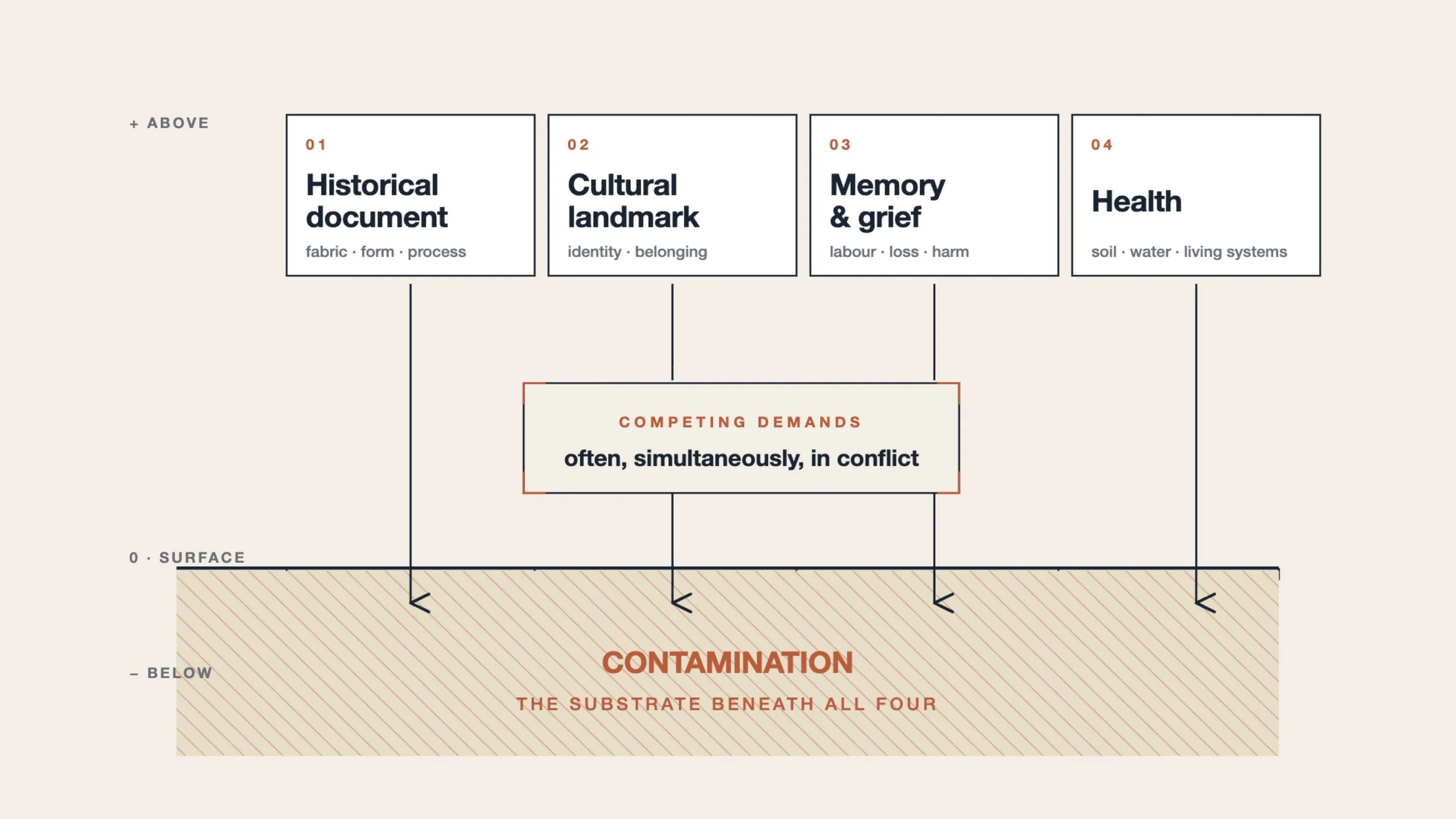
Competing demands on toxic heritage sites.